Raft of the Medusa
In the depiction of man’s struggle against the overwhelming powers of nature, it was common for Romantic artists to paint ships in danger at sea. Vogt (1973) speculated, “they reflect not only a basic feeling of political insecurity, but also the threat posed by the ‘advances’ of civilization” (p. 110). One of the most significant works of the era, Raft of the Medusa by Théodore Géricault, embodies such qualities. It expresses not only man’s vulnerability against nature, but also man as a victim of man’s own brutality (Harris & Zucker, n.d.c). Raft of the Medusa marks a change in history painting because it depicts a “needless modern tragedy” as a historic event (Linduff et al., 2005, p. 416).
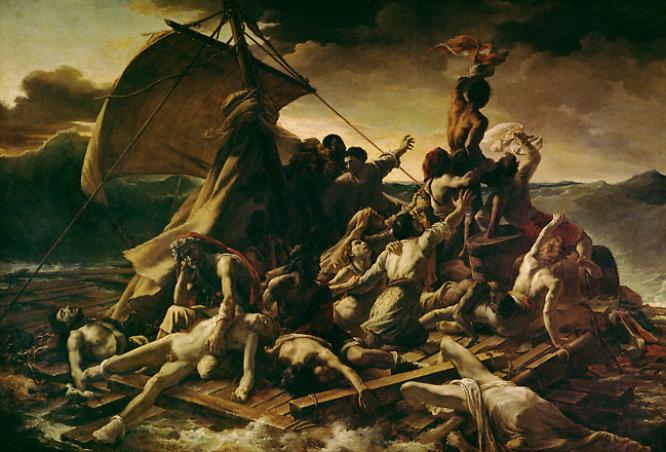
In 1816, the Medusa wrecked off the West African coast (Brown, 2001). The Medusa’s captain, whose position was received from aristocratic connections, not earned (Linduff et al., 2005), refused the advice of experienced naval officers under him (Crow et al., 2007). The captain and senior officers took the lifeboats, leaving 150 people to a hastily built raft (Linduff et al., 2005). The captain then abandoned the raft when the crew cut the towline so the lifeboats could make it quickly to shore (Brown, 2001).
The 150 raft passengers were left to float at sea for 13 days on a makeshift raft, enduring numerous horrors (Brown, 2001). There were so many people on the raft that the passengers were initially forced to stand with the water at their waists. The weight was too much for the raft to float on the surface. After six days adrift, the number of passengers was reduced to 30 by storms, mutiny, accidents, and suicides. Those left resorted to cannibalism to stay alive. The strongest passengers killed the ones closest to death in order to stretch the provisions (Crow et al., 2007).
The passengers briefly spotted the Argus, another ship from the original convoy, but it was too far away to see them. By the time the Argus found the raft, only 15 passengers survived (Brown, 2001). The wounded, emaciated survivors were taken to Senegal, where five more died. Only 10 of the original 150 made it back to France (Crow et al., 2007)
The Parisian government tried the cover the story, but survivor Henri Savigny, the ship’s doctor, published his first-hand account of the event. Savigny was Géricault’s main source for the painting (Brown, 2001). Raft of the Medusa is at once a record of the tragedy and an indictment on the government responsible for the event. Traditionally, artworks that made a political statement were propagandizing the existing regime. Here, Géricault is critical (Linduff et al., 2005).
Géricault’s initial intent was to depict the most horrific incidents from the raft, but instead chose to immortalize the moment the survivors first saw the Argus (Brown, 2001). No one knows if the ship has seen them, but the group rallies into one final action to attract the ship’s attention (Crow et al., 2007). Harris and Zucker (n.d.c) noted that the collection of figures become one singular mass with a common intent. The passengers had dragged themselves from exhaustion and despair. Survivors had climbed over dead bodies to signal the ship. The slouching, resigned figure on the lower left, however, recognizes the attempt as pointless—the other ship is a dot on the horizon (Brown 2001).
Crow et al. (2007) claimed, “the finished painting is a complex hybrid of the hyper-traditional (a centralized pyramidal arrangement of nude figures) and the unexpected (building it on a pitching sea with a cast of contemporary, semi-anonymous victims)” (p. 71). Géricault created a drama typical of Romantic painting, but he adapted classical visual devices to express a theme of conflict. The influence of earlier art periods and Gécault’s classical training is apparent in the precision of anatomical form. The dramatic gestures reflect his study of Michelangelo and Rubens. The use of chiaroscuro, diagonal composition, and agitated poses allude to Baroque styles of painting (Linduff et al., 2005). Brown (2001) stated: “futility and irony infuse the entire composition; for example the shirt-waving figure’s muscular back is a cruel parody of the classical statue fragment known as the Belvedere Torso, long admired by the academics” (p.111).
Raft of the Medusa presents the subject as an idea, not an accurate account of the event. In reality, the bodies were starved and disfigured with wounds and sun poisoning. Instead, Géricault depicted the athletic male nude on a larger-than-life scale (Crow et al., 2007). The figures are classically inspired heroic nudes rather than emaciated bodies, but Géricault painted them with a greenish-gray pallor after studying corpses at the Paris morgue (Brown, 2001). He added extra figures for compositional purposes. Even though the raft had lost 135 passengers, the survivors are crowded in the composition (Crow et al., 2007).
The painting hangs at a low level in the Louvre. The proximity of the painting to the viewer makes the painting even more impactful. The image is arranged in a way that pushes the figures forward in the viewer’s direction. The diagonal tilt of the composition and the precarious jumble of bodies creates the impression that the figures will spill out of the pictoral plane. Amidst the frenetically seething bodies and the turbulent waves, an open hand of the unconscious youth extends toward the viewer. The gesture is tender and vulnerable, and it humanizes the unconscious form. It invites the viewer into the painting, and demands he or she engages with the painting on an emotional and personal level (Crow et al., 2007).
Raft of the Medusa demonstrates a number of the qualities that galvanized the Romantic Movement. Its destabilized composition is arranged on dramatic diagonal lines, it represents a strong sense of emotion, and depicts the struggle of man against nature (Harris & Zucker, n.d.c). Truly, the Raft of the Medusa by Théodore Géricault is a prodigious example from the Romantic period. It is beautiful in craft, and its emotional impact is a powerful one.
