Themes
While reason dominated the previous period associated with Neoclassical art and The Enlightenment (Linduff et al., 2005), Romantics emphasized feelings and emotions, faith and intuition, and imagination and spontaneity (Viault, 1990). They preferred imaginary and exotic subjects to didactic Neoclassical history paintings (Galitz, 2004), and their distrust of rationalism inspired the expression of spontaneous, individual feelings (Linduff et al., 2005). Artists moved away from the classical approach to drawing and proportion in favor of a more expressive and gestural technique (Wikipedia, 2012). Newton (1962) claimed that subjectivism asserted itself on the objective sensibility of Neoclassical art.
Subjects from Literature and the Exotic
Romantic artists embraced the exotic and unfamiliar (Wikipedia, 2012). Many artists depicted scenes from the Middle East & North Africa, or scenes inspired by literature such as the works of Byron or Shakespeare. There was an escapist attitude behind these works (Galitz, 2004), as if the artists sought to forget the banality of the Western world and its modern rationalization and industrialism.
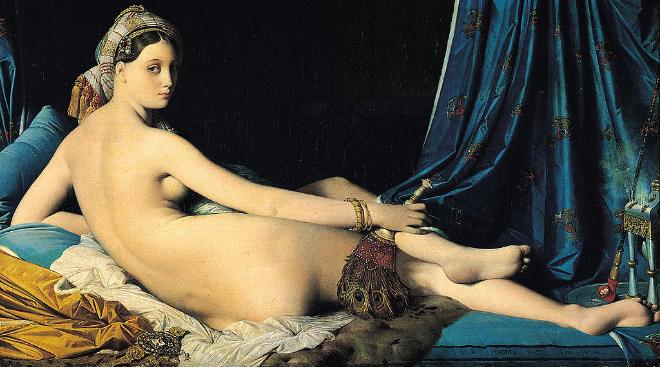
La Grande Odalisque by Jean-Auguste-Dominique Ingres, 1814
It was discussed earlier that, despite general categorization as a Neoclassical artist, Ingres was, in actuality, a bridge between movements. His most Romantic work, La Grande Odalisque, is a prime example of Orientalism. (It must be noted that, in the context of Romantic art, Orientalism referred to Middle Eastern and North African subjects.) Odalisque caused a scandal when it was first exhibited at the Salon in Paris because it featured a female nude. A nude Venus was acceptable, but this was a woman from a harem. Ingres bucked classical accuracy of anatomy for greater expression of sensuality. The model’s torso is so elongated that critics complained she had extra vertebrae. Her left leg is in an anatomically impossible position, yet it conveys a languidness that underscores the sensuality of the work. La Grande Odalisque is not an accurate account of a harem, but a construction that caters to the fascination with exotic luxury sparked by French colonialism (Harris & Zucker, n.d.b).
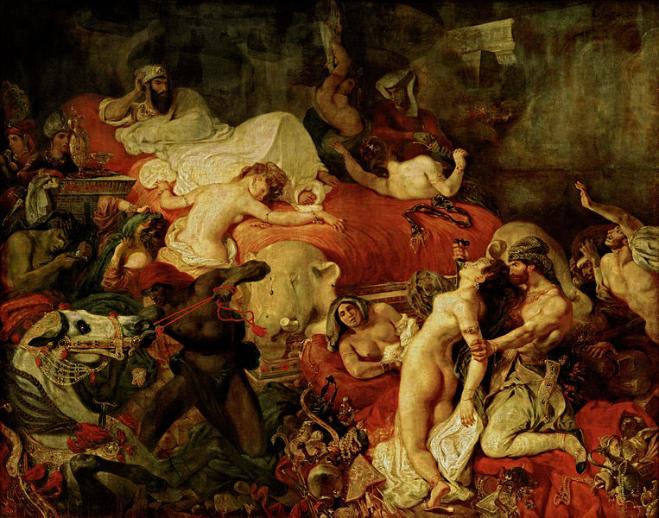
Death of Sardanapalus by Eugène Delacroix, 1827
If Ingres was an unwitting Romantic painter, Eugène Delacroix was definitively one. His painting, Death of Sardanapalus, exemplified both Orientalism and subjects derived from literature. Delacroix’s painting was inspired by Byron’s tragic historical play, Sardanapalus. The scene depicts Assyrian ruler Sardanapalus on his own funeral pyre. Instead of facing a shameful defeat at the hands of invaders, he chose to burn himself and all his belongings, including horses and concubines (Artble, 2012). Sardanapalus looks down indifferently from the top of his bed as soldiers kill the women. Delacroix eschewed all classical ideals with this painting, shocking the French public at the time of its exhibition. Rather than the carefully constructed Neoclassical space, Delacroix crammed the picture plane full of bodies and objects (Harris & Zucker, n.d.a). The scene of Sardanapolus’ death is not the heroic suicide of Socrates (Linduff et al., 2005), but selfish and callous.
Fear, Death, and the Irrational
In rebellion against their Neoclassical forebears, Romantic painters valued emotions and intuition over reason (Linduff et al., 2005). They believed aesthetic experience was derived from strong emotions (Wikipedia, 2012), and had particular interest in the mysterious, irrational, and the visionary (Linduff et al., 2005). Such emphasis is evidenced in the trend of painting concerned with nightmares, death, and fear (Vogt, 1973). Artists Fuseli, David, and Goya exemplify the Romantic fascination with nightmares, death, and fear, in three paintings, respectively.
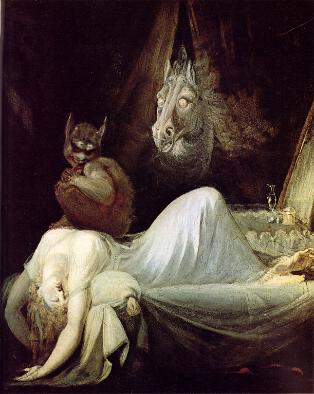 The Nightmare, by Henry Fuseli, 1781 Johann Heinrich Fuseli once said that dreams were “one of the most unexplored regions of art.” In his painting The Nightmare, a young girl is depicted in the terrifying, and almost ecstatic, throes of a nightmare. The Goblin squatting on her chest represents the oppressiveness of the dream, and the stallion looming over her embodies the wildness and violence of the psyche at its most primal level (Brown, 2001). | 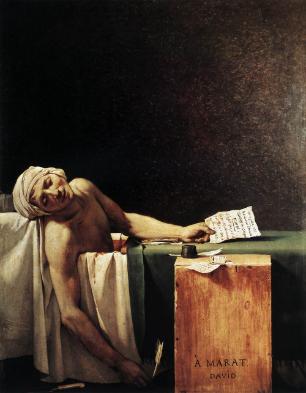 Death of Marat, by Jacques-Louis David, 1793 With Death of Marat, Neoclassical painter Jacque-Louis David temporarily slipped into the Romantic genre. He depicted the murder of French revolutionary leader Jean-Paul Marat with all the horror and violence that would make any Romantic proud. Marat was pictured after being stabbed in his bath, where he often worked. The bathtub setting amplifies the carnage as the water turns bloody and his towel becomes a funeral shroud (Vogt, 1973). |
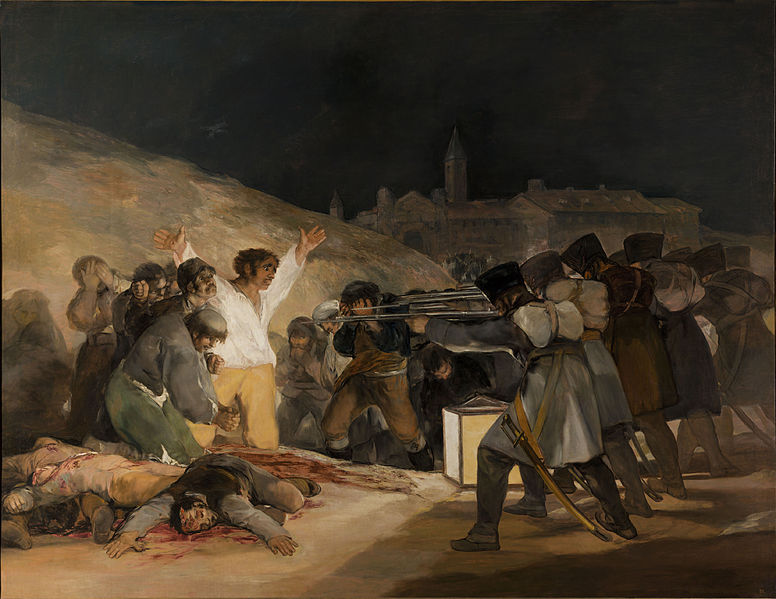
The Third of May 1808, by Francisco Goya, 1814
Francisco Goya’s painting The Third of May 1808, according to Vogt (1973), veers visually between aggression and passivity. Goya’s history paintings focused on the corrupt aspects of his time (Vogt, 1973). This painting depicts the execution of Spanish men by Napoleon’s soldiers. The sheer scale of the life-sized painting pulls the viewer into a moment of horror and desperation. The soldiers are dehumanized by the identical repetition that presents them as machines (Elements and principles of design, n.d.). In contrast, the man about to be shot is individualized by color and lighting, making him more human and relatable. The emphasis on him as he stands, Christ-like, creates an immediate intimacy. The viewer is forced to participate in the scene as the man, consigned and terrified, faces his death.
Underscoring the changing themes was a marked compositional shift in Romantic art. Evidenced in the three works mentioned above is an employment of asymmetrical balance and imposing negative space, rather than the refined balance of Neoclassicism. One will notice in all three paintings that the upper halves of the compositions are empty. The weight of the void threatens to overtake the main subjects of the works, expressing a sense of futility and terror, as each subject is lost into unknown worlds of nightmare and death (Vogt, 1973). The effect is even more apparent in comparison to the refined balance and stable use of space in David’s classical Death of Socrates, or Ingres’s Apotheosis of Homer.
Untamed Nature
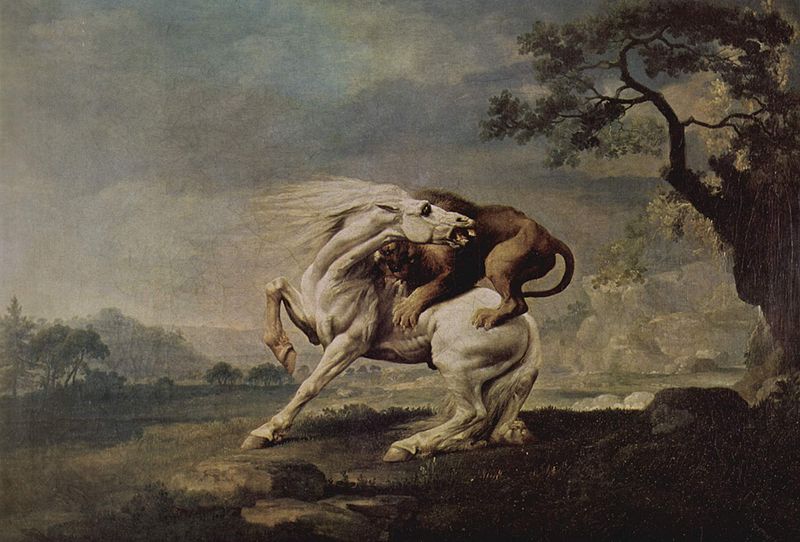 Lion Attacking a Horse, by George Stubbs, 1765 | The nineteenth century aesthetic was centered on the sublime, specifically that which was evoked by violent and terrifying images of nature (Galitz, 2004). Romantic artists focused on trepidation, horror, and awe in the face of the untamed wild (Wikipedia, 2012). Wild animals held a certain fascination for romantic painters as representation of both a force of nature and a metaphor for human behavior. Galitz (2004) argued, “images of wild, unbridled animals evoked primal states that stirred the Romantic imagination” (para. 5), illustrated in The Start of the Race of the Riderless Horses (1820) by Horace Vernet. |
The ideology that the sublime was invoked by awe and terror is evidenced in French and British paintings of shipwrecks and other expressions of man’s struggle against the power of nature. Nature’s uncontrollable power and propensity for cataclysm offered an alternative to the ordered world of the enlightenment (Galitz, 2004). The romantics canonized the concept of struggle and had a particular affinity for the struggle of man against the overwhelming forces of nature (Linduff et al., 2005). After Géricault painted Raft of the Medusa, the depiction of apocalyptic events became a popular trend in history painting. Artists focused on disasters caused by divine wrath or extreme natural events (Wikipedia, 2012), such as in Joseph Mallord William Turner’s Snow Storm: Hannibal and his Army Crossing the Alps.
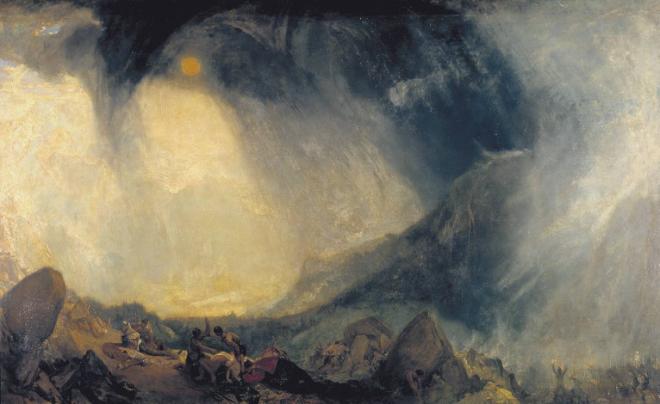
Snow Storm: Hannibal and his Army Crossing the Alps by J.M.W. Turner, 1812
The Romantic Landscape
Landscape painting was first elevated to a high genre of painting during the Romantic period (Harris & Zucker, n.d.c). Painters used landscapes as a means to express personal thoughts and emotions, as well as to communicate a sense of the sublime through the contemplation of nature (Linduff et al., 2005). The Romantic sensibilities first emerged in landscape paintings around 1760 when British artists began painting wild landscapes, storms, and gothic architecture (Wikipedia, 2012). German painters also embraced such themes in landscape paintings, exemplified in Caspar David Friedrich’s painting The Abbey in the Oakwood.
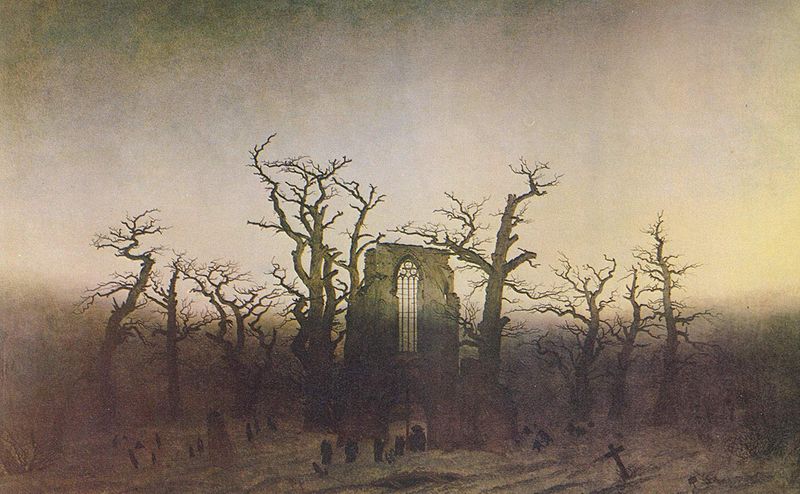
The Abbey in the Oakwood by Caspar David Friedrich, 1809-10
A group of painters known as the Hudson River School were the most prominent American landscape painters (Wikipedia, 2012). They depicted the American landscape as a god-given paradise and celebrated a nationalistic spirit. Initially, many nineteenth century American artists studied in Europe and brought Neoclassical styles and themes with them to America. The intellectual subjects of Neoclassicism, however, held little appeal for the American people (Linduff et al., 2005). American painters gave some attention to old world ruins that communicated Gothic feelings of death and decay and the Romantic idea that nature would remain after the fleeting institutions of man. More often, however, American artists focused on distinctly American scenes in an effort to differentiate themselves from European artists (Wikipedia, 2012). By the 1820s, the American landscape was the preferred subject for American artists (Linduff et al., 2005). According to Linduff et al. (2005), “Landscape seemed an especially democratic art, for its meaning was immediately accessible to the public, without scholarly reference” (p. 429).
 The Oxbow by Thomas Cole, 1836 | 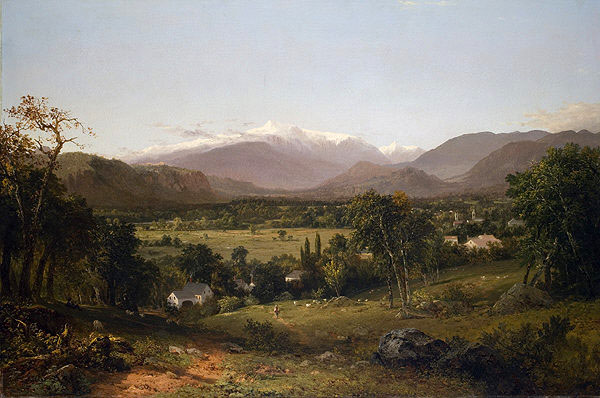 Mount Washington by John Frederick Kensett, 1851 |
History Painting
A mark of Romanticism’s rebellion against Neoclassicism is evidenced in the rejection of classical scenes in favor of medievalism. The Romantics appreciated any aspect of art or nature that they perceived as medieval. Style troubadour, a subset of Romanticism, was a type of French history painting that often depicted medieval and Renaissance themes (Wikipedia, 2012). Additionally, there was a large emphasis on national traditions in Romantic painting that contributed to the development of nationalism in Europe during the nineteenth century (Viault, 1990).
Another theme central to Romantic art was the ideal of revolution. Many Romantic paintings depicted for the first time sensational themes and political commentary that would become increasingly common in the history of art (Linduff et al., 2005). The early part of the Romantic era was set against a backdrop of political and social unrest spawned by the French Revolution and Napoleonic wars. Eugène Delacroix’s Liberty Leading the People and Théodore Géricault’s Raft of the Medusa both depicted current events, signifying a change in history painting to contemporarily relevant historical scenes, rather than religious or mythological depictions (Wikipedia, 2012).
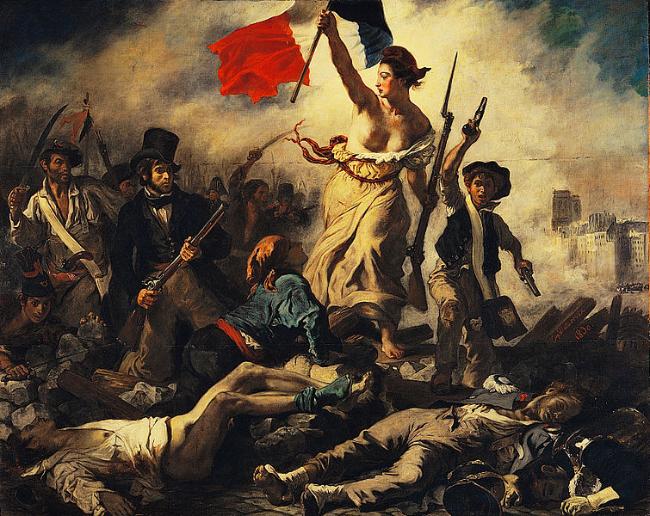
Liberty Leading the People by Eugène Delacroix, 1830
